|
|
Clavicle Fracture CPT
Clavicle Fracture Indications
- Open fracture
- Associated neurovascular injury
- Impending skin compromise
- Shortening >20mm
- Significant comminution
- Scapulothoracic dissociation
- Floating shoulder
- Bilateral clavicle fx
- Ipsiliateral UE fx
- Nonunion
Clavicle Fracture Contraindications
- Non-displaced fractures (no comminution, <3mm displacement)
- Infection
- Elderly, low-demand, high surgical risk patients
Clavicle Fracture Alternatives
- Non-operative treatment
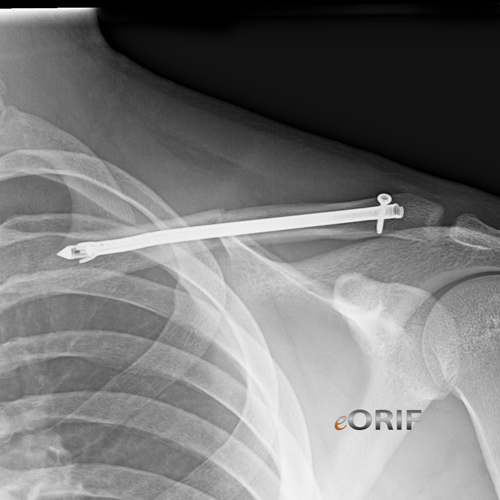
- Intramedullary pin fixation: 100% union, 50% complication rate (Strauss EJ, JSES 2007 pending publication) Can be done with specially designed screw, or 6.5mm cannulated screw.
Clavicle Fracture Pre-op Planning / Special Considerations
- Accumed congruent clavicle plate www.acumed.net. Often need to use plate labeled "right" for left side and vise versa.
- Arthrex Clavicle Plate
- Stryker VariAx Clavicle Locking Plate
- Trimed Clavicle Plate
- Smith & Nephew Peri-Loc Clavicle Plate
- Consider anterior inferior plating with 3.5mm pelvic recon plate, lag screws and bone graft.
- Consider using AO locking plates
- ORIF c compression plateing = load bearing
- Intramedullary pins/screws = load sharing, provide resistance to bending moments; no rotational stability. No elevation beyond 90 degrees for 6wks.
- Consider using shoulder positioner (Spyder Smith/Nephew).
- Early postoperative failure of Sonoma CRx has been reported (Wilson DJ, Orthopedics 2013;36:876
- Anterioinferior plating with 2.7mm plates may require less hardware removal. (Formaini, .Orthopadics 2013 Jul;36(7):e898-904).
Superior versus anteroinferior plating of clavicle fractures.
Clavicle Fracture Technique
- Pre-operative antibiotics, +/- regional block
- General endotracheal anesthesia
- Modified beach chair position. All bony prominences well padded.
- Prep and drape in standard sterile fashion.
- Oblique saber incision, raise skin flaps.
- Try to carefully preserve Cluneal nerves
- Dissection to clavipectoral fascia
- Incise fascia along superior border of clavicle.
- Anatomically reduce fracture fragments and provisionally hold in place with k-wires/suture/reduction forceps.
- Select pre-contoured plate and adjust as needed. Generally 3 holes (6 cortices) of fixation on either side of fracture.
- Apply plate with standard AO technique.
- Irrigate.
- Close in layers.
Clavicle Fracture Complications
- Infection
- Refracture
- Delayed union / nonunion
- Hardware failure
- Malunion
- Incisional scar (cosmesis)
- Potentiall visible plate due to its subcutaneous location
- Numbness below the incision (supraclavicular nerve injury)
- Painful hardware
- CRPS
- Shoulder pain
- Shoulder stiffness
- Risk of anesthesia including heart attack, stroke and death
- DVT/PE
Clavicle Fracture Follow-up care
- Post-op: sling for comfort, no overhead motion. Immediate pendelum ROM exercises.
- 10-14 Days: Wound check, sutures removed. Start PT for gentle ROM exercises. No resistive exercises/activities. Sling as needed for comfort.
- 6 weeks: Xrays, if union is evident begin strengthening and resistive exercises. No contant athletics.
- 3 months: Repeat xrays. If pt is painfree and union is obvious pt may return to sport. If no signs of union, consider bone stimulator, see Nonunion. Generally avoid contact sports and heaving lifting for 4-6 months.
- Nonoperative outcomes: (Robinson CM, JBJS 2004;86A:778).
- Mean time to union = 28.4 weeks for non-operative treatment and 16.4 weeks for operative treatment for displaced clavicle fractures. (McKee MD, JBJS 2007;89A:1).
- Shoulder Outcome measures.
Clavicle Fracture Outcomes
- Mean time to union = 28.4 weeks for non-operative treatment and 16.4 weeks for operative treatment for displaced clavicle fractures.(McKee MD, JBJS 2007;89A:1)
Clavicle Fracture Review References
- Master's Techniques: Shoulder
- Rockwood and Green's Fractures in Adults 6th ed, 2006
- OKU - Shoulder and Elbow 2nd ed, 2002
- Zenni EJ Jr, Krieg JK, Rosen MJ: Open reduction and internal fixation of clavicular fractures. J Bone Joint Surg 1981;63A:147-151.
- Nordqvist A, Redlund-Johnell I, von Scheele A, et al: Shortening of the clavicle after fracture: Incidence and clinical significance. A 5-year follow-up of 85 patients. Acta Orthop Scand 1997;68:349-351.°
- Kim W, McKee MD. Management of acute clavicle fractures. Orthop Clin North Am. 2008 Oct;39(4):491-505
- Canadian Orthopaedic Trauma Society. Nonoperative treatment compared with plate fixation of displaced midshaft clavicular fractures. A multicenter, randomized clinical trial. J Bone Joint Surg Am. 2007 Jan;89(1):1-10.
- McKee MD, Pedersen EM, Jones C, Stephen DJ, Kreder HJ, Schemitsch EH, Wild LM, Potter J. Deficits following nonoperative treatment of displaced midshaft clavicular fractures. J Bone Joint Surg Am. 2006 Jan;88(1):35-40.
|
