|


|
synonyms: humerus fracture, humeral shaft fx, humeral shaft fracture, broken arm
Humeral Shaft Fx ICD-10
A- initial encounter for closed fracture
B- initial encounter for open fracture
D- subsequent encounter for fracture with routine healing
G- subsequent encounter for fracture with delayed healing
K- subsequent encounter for fracture with nonunion
P- subsequent encounter for fracture with malunion
S- sequela
Humeral Shaft Fx ICD-9
- 812.21(fracture of shaft of humerus, closed)
- 812.31(fracture of shaft of humerus, open)
Humeral Shaft Fx Etiology / Epidemiology / Natural History
- Uncommon, 3% of all fractures
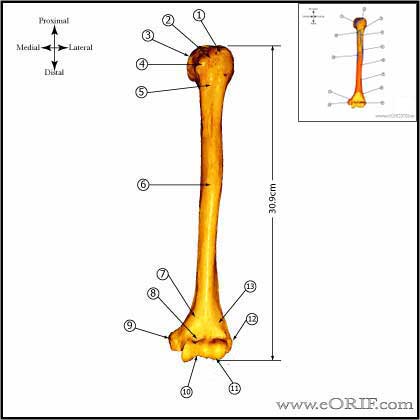
Humeral Shaft Fx Anatomy
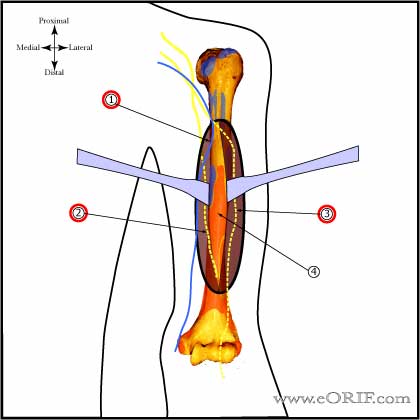
- Musculocutaneous N pierces coracobrachialis 5-8cm distal to coracoid, supplies biceps,coracobrachialis & bracialis
- See also Arm anatomy.
Humeral Shaft Fx Clinical Evaluation
- Pain, swelling, deformity of arm.
- Crepitus and motion at fracture site.
- Document neurovascular exam, especially radial nerve.
Humeral Shaft Fx Xray / Diagnositc Tests
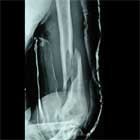
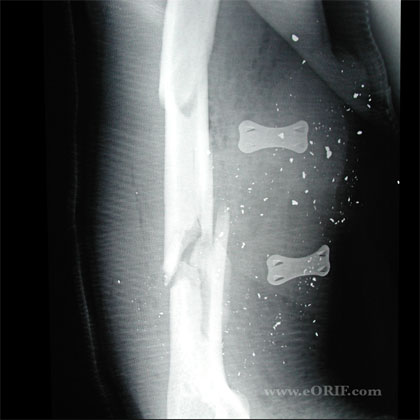
- A/P and lateral views of the humerus generally clearly demonstrate fracture.
- Consider shoulder and elbow films if there is any concern for intraarticular extension.
- MRI /CT generally not needed.
Humeral Shaft Fx Classification / Treatment
- AO classification
- Majority treated non-surgically-hanging arm cast, functional brace(Sarmiento), coaptation splint. Hanging arm cast is not recommended for transverse fractures due to potential for fracture distraction.
- ACCEPTABLE REDUCTION =20° anterior angulation, 30° varus, 15° malrotation, 3cm shortening
- Functional bracing =96-100% union, brace should be put on with arm relaxed and hanging at side, pendulum exercises should be begun immediately. Hand/wrist exercises aid in decreasing swelling. Brace must be adjusted as swelling subsides to maintain compression. Only 2% of fx heal with deformities >25 degrees . Xrays should be taken when brace placed, 1 wk, and monthly thereafter. Overall healing takes 11.5wks. Closed fractures @9.5wks, open fxs @14wks. 5.8% open fx will have nonunion, 1.5% closed fx's. (Sarmiento A JBJS 2000;82A:478) (Koch PP, JSES 2002;11:143). Bracing is contraindicated in patients with ipsilateral brachial plexus palsy. (Brian WW, JBJS 1990;72A:1208).
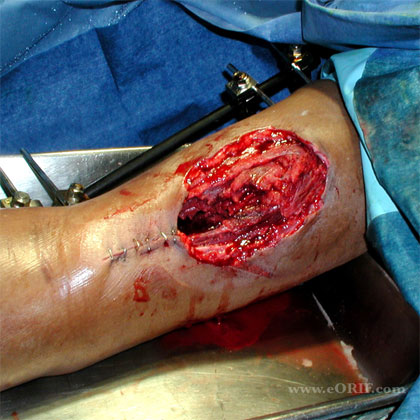
- Operative indication =multi trauma, floating shoulder, floating elbow, bilateral, nonunion, open, vascular injury, neurologic injury, obesity, pathologic fx, segmental, plexus injury, progressive radial N palsy, distal intraarticular fx. Low-velocity GSW is not an indication.
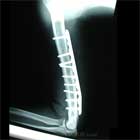
- Humeral Shaft Fracture ORIF 24515: screws should be placed in different planes because osteons of humerus are in creating stress riser like splitting log
- ORIF vs IM nail: ORIF has 90% risk reduction for shoulder impingement symptoms and a 75% risk reduction for reoperation. No difference in infection rate, nonunion rate, and radial nerve palsy.
- Intramedullary nail. (Bhandari M, Acta Orthop. 2006;77(2):279-84)
- Humeral Shaft External Fixation
- Radial nerve palsy: exploration of radial nerve palsy in closed fractures is not recommended. Radial nerve transection is associated with open fractures, but direct repair has not shown good functional outcomes. (RingD, J Hand Surg 2004;29A:144).
Humeral Shaft Fx Associated Injuries / Differential Diagnosis
- Radial nerve palsy=pts with closed fx with radial nerve injury should be treated with fracture bracing, cock-up wrist splint and observation of radial nerve with delayed exploration at 3-4 months in there are no signs of return. (Pollak EH, JBJS 63A:239;1981). Transection most commonly occurs with spiral oblique fx throught the distal 1/3. Neuropraxia commonly seen with middle and distal 1/3 fx’s (Holstein A, Lewis GB, JBJS 1963:45A;1382)
- Radial nerve transection: associated with poor results even with repair (RingD, J Hand Surg 2004;29A:144).
- Brachial artery injury
- Proximal humerus fracture
- Distal humerus fracture
Humeral Shaft Fx Complications
- delayed union = failure to unite in 2-3 months
- nonunion 4-6 months
- malunion
- Radial nerve palsy-most recover in 3-4 months, pts should be placed in cock-up wrist splint, given thumb abduction and finger/wrist extension exercises to avoid contracture. EMG at 6 wks if no signs of recovery. Brachioradialis should be first muscle to return. 11.1% of closed fx have associated Radial nerve palsy, 0.2% in closed fx's fail to recover. 18% open fx. 60% have nerve entrapped in fx. (Bostman O, Acta Orthop Scand 1986;57:316) . (Shaz JJ, Bhatti NA: CORR 1983;172:171. (Holstein A JBJS 1963;458:1382).
Humeral Shaft Fx Follow-up Care
- Non-op: posterior splint / coaptation splint.
- Post-op: Posterior splint, NWB.
- 7-10 Days: Remove splint, begin passive shoulder and elbow ROM. Stress elbow ROM. Place in Humeral fracture brace for non-op patients.
- 6 Weeks: Begin strengthening exercises provided fracture union is evident on xray.
- 3 Months: Ensure full restoration of shoulder and elbow ROM. Consider bone stimulator if union is delayed. Sport specific rehab.
- 6 Months: return to full activities / sport.
- 1Yr: Follow-up xrays, assess outcomes.
- Immediate weight bearing on a plated humerus fx with the use of crutches of a walker has been shown to safe. (Tingstad, J Trauma 2000;49:278).
- Shoulder Outcome measures.
- Elbow Outcome measures.
Humeral Shaft Fx Review References
- Carroll EA, JAAOS 2012;20:423
- Rockwood and Green's Fractures in Adults 6th ed, 2006
- Farragos AF, Schemitsch EH, McKee MD: Complications of intramedullary nailing for fractures of the humeral shaft: A review. J Orthop Trauma 1999;13:258-267.
- Zagorski JB, Latta LL, Zych GA, et al: Diaphyseal fractures of the humerus: Treatment with prefabricated braces. J Bone Joint Surg 1988;70A:607-610.
- Healy WL, White GM, Mick CA, et al: Nonunion of the humeral shaft. Clin Orthop 1987;219:206-213.
- Dabezies EJ, Banta CJ II, Murphy CP, et al: Plate fixation of the humeral shaft for acute fractures, with and without radial nerve injuries. J Orthop Trauma 1992;6:10-13.
- Epps CH Jr: Nonunion of the humerus, in Bassett FH III (ed): Instructional Course Lectures XXXVII. Park Ridge, IL, American Academy of Orthopaedic Surgeons, 1988, pp 161-166
- Gerwin, Michelle, JBJS 1996;78A:1690
- Levy JC, JOT 2005;19:43
- Sarmiento A, Zagorski JB, Zych GA, Latta LL, Capps CA. Functional bracing for the treatment of fractures of the humeral diaphysis. J Bone Joint Surg Am. 2000 Apr;82(4):478-86.
- Koch PP, Gross DF, Gerber C. The results of functional (Sarmiento) bracing of humeral shaft fractures. J Shoulder Elbow Surg. 2002 Mar-Apr;11(2):143-50.
|
